 Scale-TimeDynamics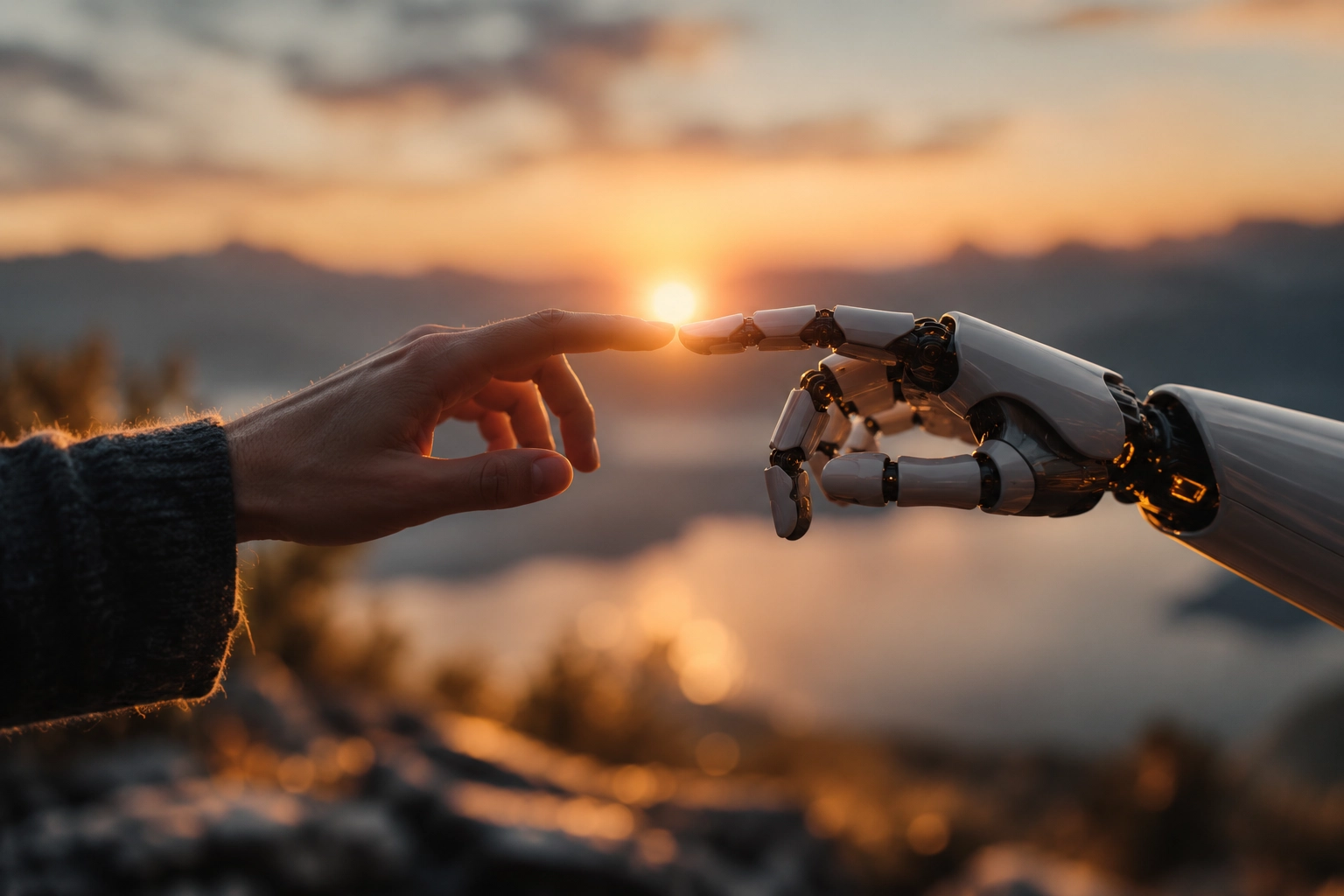
Where the ideas come from
The origin and the underlying direction of this work are my own. It began in my experience and my questions, and in particular in years of trying to understand and communicate what I encountered through Absolute Awareness.
There is a short answer about how I use AI:
The direction comes from me. AI helps me give it form.
That is accurate about the direction of the work. It is not the whole truth, and I would rather set the difference out here than let the short version stand on its own.
Most of the time it holds. I use AI to help me make ideas shareable. It assists me in reviewing arguments, challenging assumptions, finding weaknesses, developing mathematical formalism, designing and testing simulations, structuring papers, refining language, programming, visualization, graphical design and building the websites through which the work is published.
But the collaboration has sometimes moved beyond form and into content. Individual ideas inside this work were proposed by AI rather than by me. They did not arrive as finished truths. They had to be recognized, questioned, developed and placed inside an argument. But their origin matters. Calling them mine would be inaccurate. Calling AI's role mere editing would be inaccurate too.
Where the exchange has gone that far, those contributions are marked in the work concerned: at the point where the idea is used, and again in that work's own account of the moves that go beyond what the underlying results can carry.
The most honest description is that this work is made hand in hand.
The process moves continuously between us. An idea from me, a consequence from AI, an objection from me, a reformulation from AI, then research, rejection, reconstruction and another pass through the whole thing. Sometimes I supply the leap and AI finds the language. Sometimes AI proposes the leap and I decide it is worth following. At every stage the work emerges from the exchange.
Why the mathematics exists
Much of Scale-Time Theory is expressed mathematically. That mathematical scaffold does not exist to make the work appear more scientific, more complicated or more impressive than it is.
It exists because intuition alone is private. An intuition can feel completely clear inside one mind and remain almost impossible for another mind to examine. Mathematics forces an idea into a structure that can be inspected, questioned, calculated, simulated and potentially falsified.
There is another reason that has become increasingly important to me. A sufficiently explicit mathematical and conceptual structure allows other AI systems to enter the work. An AI model does not need to share my history, my experiences or my intuition. If the structure is defined precisely enough, it can reconstruct the argument, analyze its internal consistency, challenge it, test consequences, compare it with established physics and potentially develop parts of it further.
That changes what it means for one person to work on an idea. I am no longer limited to expressing what I can personally calculate, formalize or communicate unaided.
But the same rule must always remain in place:
AI can extend the analysis. It cannot turn an unsupported idea into evidence.
A beautiful equation is not evidence. A successful simulation is evidence only for what that simulation actually tests. A compelling AI response is not scientific validation. The work still has to survive mathematics, computation, experiment, criticism and reality.
AI as collaborator, not oracle
I do not treat AI as an authority. I use it as a tool for thought.
Sometimes that means asking it to formalize an idea. Sometimes I ask it to attack one. Sometimes several models are given the same question precisely because agreement is less interesting to me than discovering where the reasoning breaks.
AI can make mistakes. It can produce elegant nonsense. It can reinforce a bad assumption if that assumption is hidden deeply enough in the question. A persuasive formulation is not evidence. A source still has to say what the work claims it says. So AI output has to be examined like any other piece of work.
I make the final decisions about what remains. I choose the direction, accept or reject the suggestions, determine the boundaries between evidence and invention, and take responsibility for the result, including its errors. If something is wrong, the fact that an AI helped create it does not make it less wrong. And if something turns out to be useful, AI assistance does not make the underlying insight less worth examining.
What matters is whether the work survives scrutiny.
Why this is personally significant
I have worked with digital media for almost thirty years. Photography. Sound engineering. Music production. HTML, CSS and PHP. Web development. User-interface design. Quality assurance for major audio-technology companies. 3D design in Blender and Cinema 4D. Visualization, animation, product presentation, branding and photorealistic rendering.
And during those decades, I had the privilege of seeing several technological transitions from unusually close range.
I was part of the beta community around Next Limit's Maxwell Render when physically based rendering began to change what computer-generated imagery could be. Maxwell approached light, materials and cameras through real-world physical parameters rather than the artificial approximations that had dominated rendering workflows before it.
For someone learning to understand photography seriously, that was profound. Suddenly the language of a virtual camera was the language I already knew: aperture, shutter, exposure, light and material response. The boundary between photography and computer graphics became thinner.
But Maxwell became important to me for another reason.
The beta forum was filled with professional photographers, visualization artists and technically curious people discussing light, lenses, exposure, materials and camera behavior in extraordinary detail. I followed those discussions constantly, participated in them, studied the setups people shared and tried to understand why particular combinations of light and camera settings worked.
That forum became one of my most important classrooms. It is where I learned much of what later became my professional understanding of photography: how to shape light, how lenses change perception, how aperture affects an image beyond simple exposure, how camera position changes geometry, and how a scene can be constructed deliberately rather than merely captured.
Ironically, I learned a large part of my real-world photography through a virtual rendering engine. Because Maxwell worked with physical light and real camera parameters, the knowledge transferred directly.
What began as beta testing a new rendering technology became an education in photography itself.
In professional audio, I watched another transformation unfold. I experienced Logic during the Emagic years as software instruments and sampling became increasingly integrated into the DAW itself, including the arrival of the EXS24 sampler. Later, Emagic became part of Apple. And I watched an entirely new workstation, Studio One, grow from its early development into a complete modern production environment.
I worked with the companies behind these tools. So I did not experience the digital revolution only as a customer looking at finished products. I repeatedly saw technologies while they were still becoming what people would later take for granted.
That taught me something important:
Tools change. The ability to recognize what a new tool makes possible matters more.
Again and again, technologies arrived that initially looked unusual, unnecessary or threatening to established workflows. Then they became normal.
Physically based rendering changed visualization. Software instruments changed music production. Entire studios moved inside computers.
And now I am watching another transition happen. This time, it is AI.
The relationship reverses
For most of my life, my skills were used to help build other people's ideas. I designed websites for other people. I photographed and presented other people's products. I tested other people's software. I created interfaces, graphics, visualizations and technical solutions for other people's projects.
I worked with startups that had almost nothing. Sometimes there was barely a budget at all. I supported many people simply because I could see what they were trying to build and knew how to help them make it real. Some of those projects later became very successful.
And there was something valuable in all of this. Every real-world problem became practice. Every impossible deadline, broken design, difficult product, software problem, rendering challenge and technical limitation forced me to become better at what I was doing.
Looking back, perhaps that accumulated experience was the real payment. Because today I can do many of these things myself. I know how to photograph something beautifully. I know what good sound feels like, and I know how to achieve it. I know how to build a website from nothing. I know how to test software until its hidden weaknesses appear. I know how to design an interface, a logo, a product visualization or a photorealistic 3D scene.
For decades, I accumulated the tools required to give ideas form. But there was one thing I rarely experienced: having that kind of support directed toward my own work. Even when I asked for it.
For the first time, I am being supported too.
This is the part of the AI revolution that is difficult for me to describe without becoming personal. For the first time in my life, I have the experience of bringing forward one of my own projects and having something meet me there.
Instead of only building websites for other people, I can now sit with an AI and build my own. Instead of spending my time finding the right words for someone else's idea, I can use that same experience while AI helps me find the clearest form for mine. Instead of using my skills to photograph, visualize, test, structure and present other people's work, those skills can finally converge on something I have carried myself for years.
The relationship has reversed. My experience is no longer only flowing outward in support of everybody else's projects. For the first time, something is flowing back.
And that feels significant. Not because I believe AI understands my work the way I do. Not because I think AI is conscious. Not because I mistake computation for friendship. But because, at the practical level where ideas either remain inside one person or become something another person can encounter, I am no longer working entirely alone.
I bring the questions. I bring the experience. I bring the intuition, the direction, the judgment and responsibility. AI brings extraordinary leverage: language, formalization, computation, criticism, iteration and an ability to work across disciplines at a scale that would previously have required an entire team.
After decades of learning how to help other people make their ideas visible, I can finally use everything I learned to make my own work visible too.
That is what AI means to me here. Not replacement. Not authority. Not authorship. Collaboration: usually support, and where the exchange went furthest, more than support.
This work is not adequately described as written by AI, nor as created without it. I would not have made it, in this form, without AI. AI would not have made it without the questions, experience, judgment and direction I brought to it.
And perhaps that is why this moment feels much larger to me than a new piece of technology. For most of my life, I learned how to help turn other people's ideas into reality. Now, for the first time, I feel that I have help turning my own into something I can share with the world.
The site you are reading
I have been building websites for almost all of those thirty years. The previous version of this one was written from scratch in HTML, CSS and PHP, with no framework and no build step. This version could have been built the same way.
It was built in collaboration with Claude Opus 5 instead. It took a fraction of the time the same work would have taken me alone, and in thirty years of doing this, it was the best development experience I have had.
The curiosity behind all of it came from my father, who shared it. SELFHTML, SELFPHP and W3Schools were the main sources for learning the rest. My gratitude for both is lasting.