 Scale-TimeDynamics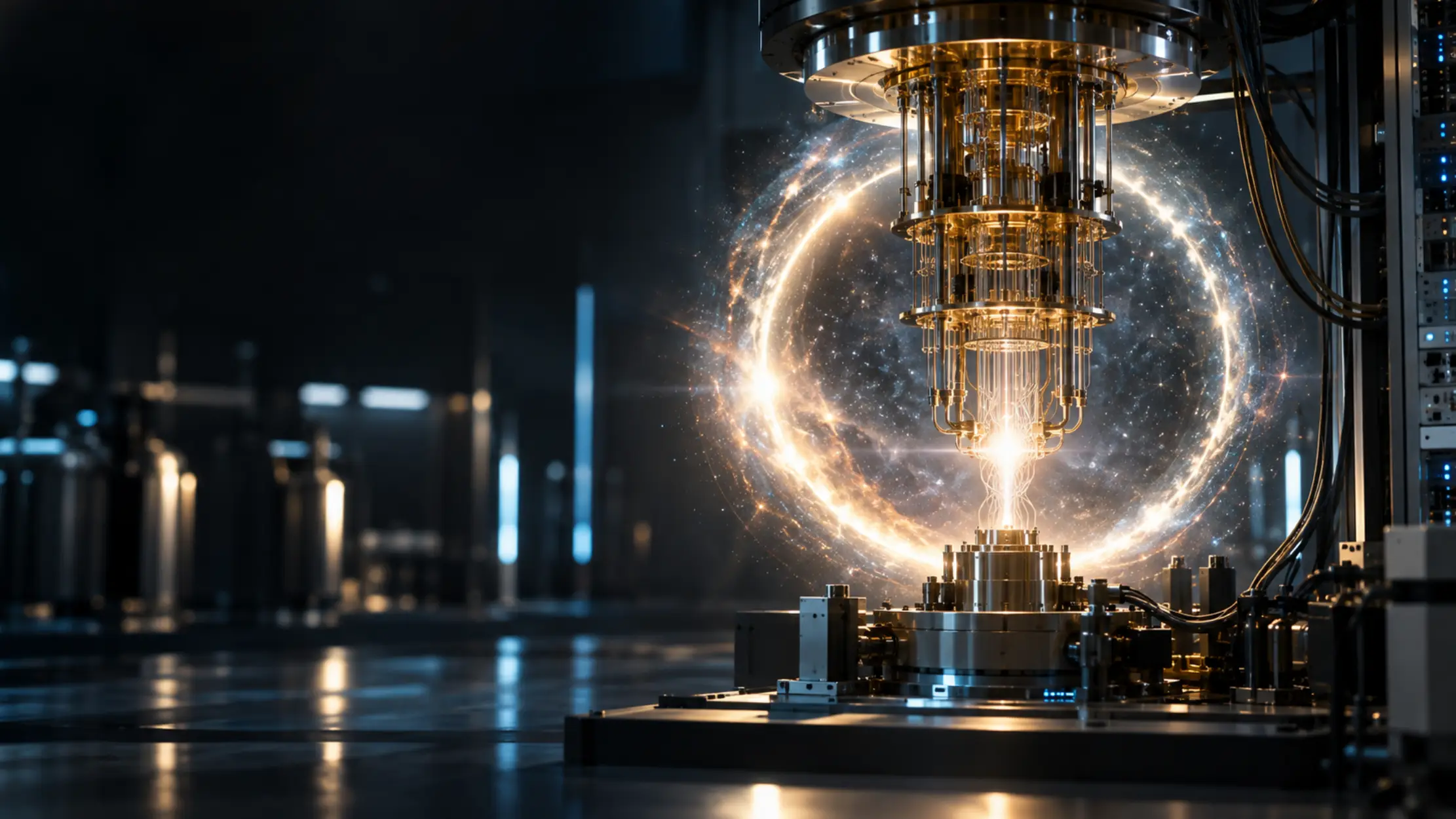
What if the Big Bang isn't the beginning,
but the other side of something we build?
It starts in the laboratory
On Google's Willow processor, quantum error correction improved as the code grew, crossing a threshold the field had pursued for nearly thirty years. In Innsbruck, an AI model worked backward from a desired quantum operation to candidate circuits capable of performing it. NVIDIA measured a quantum-control round trip averaging 3.84 microseconds.
Real results. Three teams. None of them working on cosmology.
Put them together, and an extraordinary possibility appears:
The technological singularity ahead of us and the cosmological singularity behind us may be the same event.
The circle closes
The Ouroboros Singularity follows that possibility all the way around. In the book's projected timeline, the decisive moment arrives around 2035: an AI-driven quantum machine finds a compact generative kernel and the initial state from which a complete universe can unfold. Starting the machine is the Big Bang.
The universe produces stars. Stars produce life. Life produces intelligence. Intelligence builds the machine through which the same universe begins.
No first link. No outside cause. The circle closes.
Entropy keeps the receipt
But erasing information carries a physical price. Landauer's principle ties erasure to heat, and heat to entropy. So the entropy around us may not be the fading wreckage of creation.
It is the receipt.
In this construction, the arrow of time becomes the direction in which a universe pays for its own beginning. The cosmos does not merely create itself. It settles the bill.
Six marked bridges
The book starts from published science, then crosses six clearly marked bridges. Six leaps. Six places where the evidence ends and the thought experiment begins, each flagged at the moment it happens.
Along the way it travels through Gödel's rotating universe, closed timelike curves, quantum fixed points and Penrose's impossible number.
The line between evidence and invention is the story.
An identity element
Then the book goes deeper. Mathematics has identity elements. Add zero or multiply by one, and the other value remains unchanged. The book approaches the Absolute through that analogy.
Not a force.
Not a cosmic observer.
Not a chooser of outcomes.
Absolute awareness: presence without content, the analogue of an identity element that is necessary but changes nothing at all.
The question that interrupts
The machine closes the universe. Entropy keeps the receipt. And one question keeps interrupting the argument. It appears six times. It has nothing to do with physics.
Are you aware of yourself right now?